
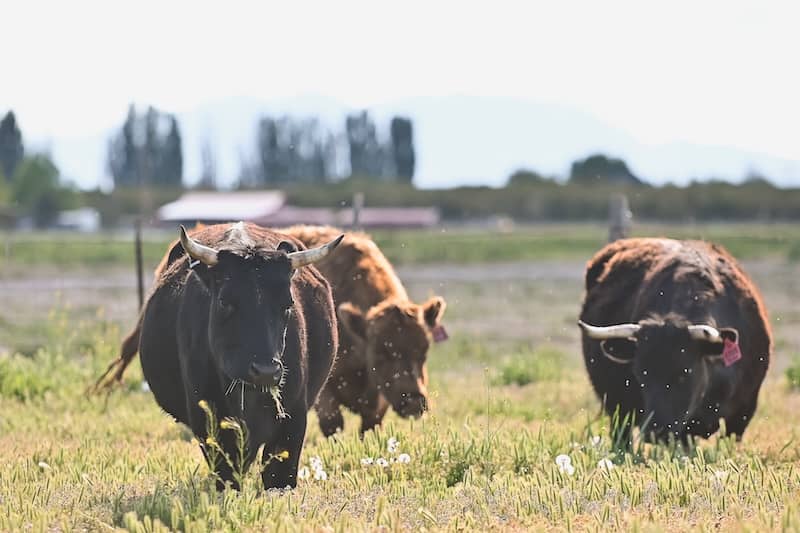
The Dexter beef cow’s story begins in the rugged landscape of southwestern Ireland. Shaped by centuries of farming traditions and the demands of the land, this small but remarkable cow endured to become one of the world’s oldest cattle breeds.
More than 200 years later, the Dexter is still valued for the hardiness, efficiency, and versatility that made it stand out from the beginning.
The Land That Shaped the Dexter Cow
Dexter cattle come from the Kerry region of southwestern Ireland. In the early 1800s, this challenging coastal region wasn’t easy to cultivate. The weather was cool and rainy for most of the year, and many fields had thin, rocky soil that couldn’t support rich pasture. Grass was often scarce, making it difficult to feed large animals.
The people who lived there were mostly poor farmers working on just a few acres of land. They couldn’t afford to keep and feed typical large cattle. They needed a dependable cow that could thrive on the limited resources the area offered.
A visitor to the area in 1810 noted that the local families preferred small, hardy cattle better suited to the tough conditions.
These farmers didn’t need the biggest animal. They needed one that could serve multiple purposes in a harsh environment.
The Kerry Cattle Connection
Dexter cattle didn’t appear overnight. The breed descended from Kerry cattle, one of Europe’s oldest native livestock breeds. The Kerry breed has lived in southwestern Ireland for centuries, and is often traced back to the mostly black shorthorn cattle brought by the early Celts.
For many years, people didn’t consider Kerry and Dexter cattle separate breeds. Instead, the Dexter was recognized as the smaller, stockier type found within Kerry herds. Farmers selected these smaller cows over generations because of their ability to thrive on rough terrain.
As time passed, those smaller cattle became more consistent from one generation to the next. By the late 1800s, they were recognized as a distinct breed. The first Kerry and Dexter Herd Book, published in 1890, listed 26 Dexter bulls and 210 Dexter cows separate from the larger Kerry population.
Later, blood typing research confirmed that, although the two breeds are closely related, they are genetically different and shouldn’t be freely interbred.
The Man Behind the Name
Unlike most cattle breeds, the Dexter isn’t named after the place it came from. It’s named after a man.
Not much is known about “Mr. Dexter.” Some sources identify him as Christopher Dexter, an agent who managed the large, 2,400-acre Dundrum House estate in County Tipperary for Lord Hawarden.
The first written description of the Dexter cow appeared in 1842. David Low, a professor of agriculture at Edinburgh University, wrote that Mr. Dexter had successfully produced his cattle by carefully selecting the best of the hardy mountain cattle of the area.
Historians still debate how much of the breed Mr. Dexter created. Some believe he developed this new type through selective breeding, while others believe he refined an existing breed. Either way, the animals became closely associated with him and eventually came to bear his name.
The Traits That Made the Dexter Beef Cow Stand Out
The cow that emerged was unlike almost any other breed. The most noticeable difference was its size. A mature Dexter cow typically stands 36 to 42 inches at the shoulder and weighs under 750 pounds. That’s nearly half the size of many other beef breeds.
The Dexter’s value came from more than its small frame. These cows were highly efficient and could stay healthy and productive on rough pasture that couldn’t support those larger breeds. They were also calm and easy to handle on working farms.
These animals mature more slowly than many commercial breeds, a factor that contributes to Dexter cattle’s beef quality and helps develop the breed’s characteristic fine texture and rich flavor.
For farmers with limited resources and land, these cattle became a valuable asset. A Dexter cow offered versatility. It took much less space and fewer resources while still providing a family with beef and daily milk.
Today, those same qualities are still prized. The American Dexter Cattle Association recognizes the Dexter as a heritage breed, and many small farms continue to raise them for their efficiency, gentle nature, and flavorful meat.
From Ireland to Farms Around the World
Dexter cattle didn’t stay in Ireland for long. In 1882, 10 were purchased by Mr. Martin J. Sutton of Oxfordshire. At first, they attracted attention mainly because of their unique small size. Farmers soon realized that there was much more to this breed, and their popularity quickly spread.
By 1925, nearly 70 herds and more than 1,100 registered Dexter cows were recorded across Britain.
The breed crossed the Atlantic in the early 1900s. More than 200 Dexters were imported to farms in Kentucky, New York, and Minnesota. As interest grew, breeders formed the American Kerry and Dexter Cattle Club in 1911. The organization later became the American Dexter Cattle Association, and still maintains the breed registry today.
Like many heritage breeds, the Dexter’s herd size shrank during the mid-1900s as the beef industry shifted toward larger, faster-growing cattle. By the 1970s, the breed was nearly extinct in the United States.
Improvement has come slowly, through the work of dedicated small-herd breeders and conservation organizations. The Livestock Conservancy now classifies the Dexter as “Recovering,” instead of the “Threatened” status the breed held for decades.
Centuries after it was shaped on the remote hillsides of southwestern Ireland, the Dexter is now thriving on small farms around the world, producing pasture-raised beef and carrying forward the traits that made it valuable from the very beginning.