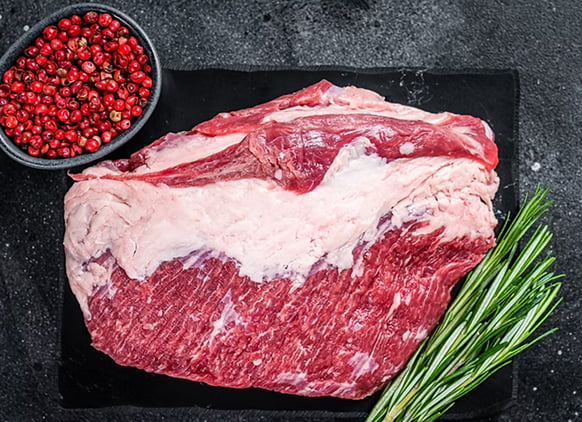


Order Grass-Fed Beef Brisket Online
Brisket and patience are synonymous. The cut comes from the heavily worked chest muscles of a steer. That sustained activity creates meat dense with collagen and connective tissue. When it’s cooked for a long time on low heat, it transforms.
Whether it goes on a smoker for 10 to 14 hours or into a covered pot for six, the brisket requires more time to prepare than almost any other cut and can give you results you can’t get anywhere else.
Our brisket comes from heritage Dexter steers raised for 30 months on regenerative pasture and dry-aged as part of our whole-steer program. Order our grass-fed brisket online. We can’t deliver patience, but we can deliver quality meat straight to your doorstep.
What Brisket Is and Why It Cooks the Way It Does
Brisket comes from the breast of the animal, below the chuck, and in front of the plate. These pectoral muscles are some of the most heavily worked in the steer. They support nearly 60% of the animal’s weight and help to stabilize the chest during movement.
All this work produces a cut with much more connective tissue than almost any other. That connective tissue is why you shouldn’t cook brisket like you would a steak. If you cook it quickly over high heat, the collagen shrinks and squeezes out all the juices, leaving you with a chewy, dry piece of meat.
If you cook brisket for a long time over low heat, that same collagen can convert to gelatin and completely change the cut.
The brisket contains two distinct muscles separated by a layer of fat.
The flat is the leaner muscle, and is uniformly thick, with a long, parallel grain. This gives you the clean, defined slices you picture when you think of Texas BBQ.
The point sits on top of the flat and is richer and more irregularly shaped. It has much more fat and a less uniform grain. The point is sometimes separated after the initial cook and returned to the smoker to develop burnt ends. These intensely flavored, caramelized cubes have become very popular in American BBQ.
A whole, untrimmed beef brisket with both muscles is called a packer brisket, and traditionally, it’s cooked in a braise or pot roast. The fat from the point melts down into the dryer, flat muscle below, adding moisture and flavor.
Out of stock
Two Ways to Prepare Brisket
There are two common ways to prepare brisket, and they both give very different results.
Smoked
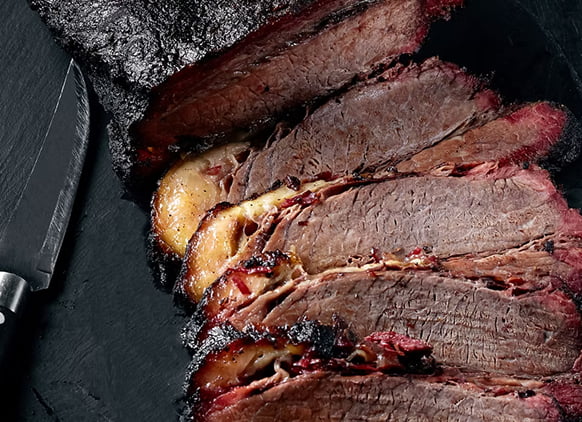
In the BBQ tradition made popular in central Texas, either the whole packer brisket or just the flat goes on a smoker set at 225 to 275 degrees Fahrenheit. It’s then smoked until it reaches an internal temperature of around 200 to 205 degrees. This typically takes 10 to 14 hours.
The low cooking temperature allows the collagen to fully convert to gelatin and the fat to render throughout the muscle.
The long cooking process creates a bark on the outside. This deeply caramelized, peppered crust helps trap the flavorful juices and keeps them from leaking out.
Braised
In the braising tradition, developed through Jewish and European pot roast cooking, the brisket cooks low and slow in a covered pot with aromatics, wine or stock, and vegetables.
After five or more hours, the collagen converts to gelatin and combines with the braising liquid to become a velvety sauce that keeps the entire cut of meat moist and tender. When it’s done cooking, the meat pulls apart easily.
The dryer, leaner flat cut has less fat and can dry out easily. When braised, the more uniform cut can absorb the liquid’s flavor and moisture throughout the long cooking process. Simmering it for a long time keeps the meat juicy as the collagen melts.
Our grass-fed and grass-finished beef brisket suits both cooking methods. The unique marbling throughout our Dexter brisket develops over 30 months on diverse pastures and carries a strong beef flavor that gives the cooked meat its distinct, delicious taste.
What Grass-Fed Brisket Tastes Like Compared to Conventional
Most of the briskets sold at grocery stores, smoked at BBQ restaurants, and offered by the largest online meat retailers come from grain-finished cattle. The heavy external fat cap on a grain-finished brisket flat is one of the cut’s most recognizable features.
This thick, white ribbon of fat on conventional brisket provides insulation and a steady source of rendered fat throughout the cook. It also offers a mild, neutral flavor to the beef.
Grass-fed brisket develops its fat differently. The external fat cap on a grass-fed flat is thinner, and the intramuscular fat created by the cow’s natural diet is more bold and earthy. The rich taste is often described as more complex and flavorful than grain-finished brisket.
On a long smoke or in a long braise, the grass-fed brisket’s flavor doesn’t disappear; it deepens and concentrates. At 30 months of maturity, the pectoral muscles of our grass-fed Dexter cattle have had twice as long to develop dense muscle fibers and depth of flavor.
Out of stock
The Dexter Brisket’s Advantage for Home Cooks
A full packer brisket from a commercial Angus cow is large, typically weighing 12 to 18 pounds before trimming. That’s a great size for a competition-grade offset smoker and a 14-hour commitment, but most home kitchens aren’t set up for that. Even if you only go with just the flat,
It can be nearly 10 pounds.
Our full-grown heritage Dexter steers are almost half the size of standard Angus steers. This means their brisket is much smaller and easier to manage. The proportion is great for a typical smoker or standard Dutch oven.
You get all the same qualities of brisket, but at a scale that fits your kitchen. For buyers who want to smoke a full brisket or braise a whole packer without the headache of a 15-pound commercial cut, the Dexter brisket is a great option.
Our high standard of care, dry-aging program, and single-farm origin give you a premium cut of beef at a size that better suits most home cooks.
Why Buy Our Grass-Fed Beef Brisket? The Dry-Aging Advantage
Most briskets aren’t dry-aged. Even producers who age their steak cuts typically process the brisket fresh or wet-age it in vacuum packaging. They reason that since the cut will be cooking for hours, it doesn’t need the flavor concentration that aging provides.
We don’t agree. Dry-aged muscle tissue adds a deep flavor that can’t be achieved any other way. If you start with a concentrated beef flavor before the cook begins, you end up with a more developed, savory finished product.
Our whole-steer dry-aging program means the brisket goes through at least 14 days of dry aging, just like the ribeye and strip. What you put in your smoker or the braising pot has a head start because the flavor created on 30 months of regenerative pasture has been concentrated through the process.
The price per pound of grass-fed brisket from our heritage single-farm operation reflects our investment in a high-quality product. It costs more to raise a cow to maturity over 30 months instead of the common 16 months. Regenerative pastures managed without synthetic inputs cost more to maintain than chemically managed land. A dry-aging program that doesn’t just prioritize the premium cuts takes more time and controlled conditions.
How Mahanaim Farms Raises Its Cattle
Mahanaim Farms is a single-farm operation along the Rio Grande River in central New Mexico. We breed, raise, and finish every animal on the same property from conception to plate. Our heritage Dexter cattle reach maturity at around 30 months on regenerative pastures managed without artificial fertilizers, herbicides, or pesticides.
After processing at a USDA facility, the entire animal is held for at least 14 days under controlled aging conditions before being cut. The brisket goes through the same whole-steer dry-aging program as every other cut. You can order grass-fed beef brisket online to see and taste the difference intentional care can make.
FAQs
What's the difference between the brisket flat and the brisket point?
The flat and the point are two different muscles that make up the whole packer brisket, separated by a layer of fat.
The flat is the larger, thinner muscle. It’s long, rectangular, and relatively uniform in thickness, with a parallel grain that produces the clean, defined slices you often see on Texas BBQ plates. It’s leaner than the point, and is often sold on its own.
The point muscle, which sits on top of the flat, is smaller, richer, and more irregularly shaped. It carries significantly more intramuscular fat than the flat and has a less uniform grain that runs at roughly a right angle to the flat’s grain.
Both muscles require the same extended low heat to become tender, but they produce different results on the plate.
What are burnt ends, and how do I make them?
Burnt ends come from the point. After the whole packer brisket has been smoked to the probe-tender stage, the point is separated, and the flat is sliced for serving.
The point is then cubed into roughly 1.5- to 2-inch pieces, tossed in a light coat of seasoning, and returned to the smoker or a covered pan in a hot oven at 300 to 325 degrees for another hour or two.
During this second cook, the additional fat in the point renders further. Additionally, the sugars in any glaze or seasoning caramelize, and the exterior of each cube develops a deeply flavored crust while the interior stays tender and rich.
Burnt ends from a grass-fed Dexter point often deliver a more defined and complex flavor than you can get from younger commercial steers. That’s because the intramuscular fat carries the assertive, pasture-raised beef taste that 30 months on regenerative land produces.
What is the brisket stall, and how do I deal with it?
The stall is one of the most common sources of frustration for first-time brisket smokers. If you anticipate it, you can save yourself a lot of stress.
As brisket cooks at a low temperature, moisture in the muscle begins to evaporate from the surface. This evaporation causes the meat to lose heat at the same rate it’s gaining heat, which can keep the internal temperature the same for hours. Even if your smoker’s heat is consistent, the meat can stay stuck, typically at 150-170 degrees Fahrenheit.
This is a normal part of the process. Many manage the stall in one of two ways. You can:
- Wrap the brisket: Once the meat begins to stall, wrap it in butcher paper or foil. This reduces surface evaporation and helps the internal temperature rise more quickly. Butcher paper is often preferred over foil because it still allows some moisture and smoke to pass through, preserving the bark’s texture.
- Wait: The second approach is to do nothing. If you wait, an unwrapped brisket will eventually push through the stall on its own as the surface dries.
Both approaches work, and the right choice depends on whether finishing time or bark texture is more important to you.
How long does it take to smoke a grass-fed brisket?
Brisket smoking time depends on cut size and smoker temperature. For this reason, many experienced cooks pay more attention to the meat’s internal temperature rather than how long it’s been smoking.
At 225 to 250 degrees Fahrenheit, most briskets need to cook for about one to one and a half hours per pound. A full packer Dexter brisket, which is significantly more compact than a commercial packer brisket, will reach temperature faster than a cut nearly twice its size.
A grass-fed brisket with a thinner external fat cap also reaches the surface Maillard reaction stage faster than a heavily fat-capped commercial brisket. This stage represents a chemical reaction between reduced sugars and amino acids.
Monitor the internal temperature after the meat has been cooking for about eight hours. The best way is with a probe thermometer inserted into the thickest part of the flat. Look for a temperature between 200 and 205 degrees. When the brisket is ready, the probe should slide in with almost no resistance.
After the brisket is done smoking, wrap it tightly in butcher paper, place it in a cooler or insulated bag, and rest for one to four hours before slicing. The resting period allows the juices to redistribute through the muscle. If you don’t let the meat rest and slice it as soon as it reaches the right temperature, it can turn out dry and tough.
How do I braise a brisket in the oven?
Braising is almost entirely hands-off and only takes a few simple steps and some patience.
- Season your brisket generously with salt and pepper, then sear in a large Dutch oven or heavy roasting pan over medium-high heat until both sides are deeply browned.
- Remove the brisket and cook the aromatics, such as onion and garlic, in the same fat until softened.
- Add a cup or two of red wine, reduce slightly, then add enough beef stock to come up roughly one-third to one-half of the way up the side of the brisket.
- Return the brisket fat-side up so the rendered fat bastes the muscle as it cooks.
- Cover tightly with a lid or foil and braise at 300 degrees Fahrenheit for four to six hours, checking at the four-hour mark by probing the flat. If it’s between 200 and 205 degrees and gives easily, it’s ready.
A grass-fed Dexter brisket flat, which is leaner than a grain-finished commercial flat, benefits from the braising liquid’s moisture throughout the cook. It’s important to keep the fat side of the brisket on top. That way, the meat can self-baste as the fat renders.
How do I slice a brisket after it's done?
There is a right and a wrong way to slice brisket. Both the flat and the point have grain directions that run at roughly right angles to each other. If you slice the whole brisket in one direction, you can cut across one muscle’s grain but follow the other’s. If you do this, you’ll find half of a slice is tender, while the other half is chewy.
The recommended way is to separate the flat from the point at the fat seam before you slice it. Slice the flat across its grain, cutting perpendicular to the long direction of the muscle fibers. This gives you relatively thin slices with a clean, defined edge.
Turn the point and slice it across its own grain, which runs in a different direction than the flat’s. For burnt ends, cube the point instead of slicing it.
Use a sharp slicing or carving knife, instead of a serrated blade, for cleaner slices. Slice only what will be served immediately, since unsliced brisket retains moisture much longer than sliced brisket and helps prevent it from drying out as much during storage.
Can grass-fed brisket be used to make corned beef or pastrami?
The brisket flat is traditionally used to make corned beef and pastrami, and our grass-fed brisket works especially well for both.
Corned beef begins with a brine cure. The flat is submerged in a salty liquid seasoned with pickling spices like coriander, black pepper, bay leaf, mustard seed, and red pepper flakes. It’s then refrigerated for five to seven days before being rinsed and simmered in fresh water until fully tender. This gets you the pink, tender corned beef used in Reuben sandwiches and traditional dinners.
Pastrami uses the same brined flat, but it’s then dried, coated in a rub of coarsely cracked black pepper and ground coriander, cold-smoked, and then steamed until tender.
A grass-fed Dexter flat’s leaner profile and more assertive beef flavor carry through both curing processes. The brine and spice can build on the already strong beef base, rather than the more neutral flavor of a heavily grain-finished flat.
The thinner fat cap on the grass-fed flat also allows the brine to penetrate more evenly than in a thick-capped commercial cut, helping ensure more consistent curing.
Why is grass-fed brisket leaner than conventional brisket, and how does that change the cook?
The difference comes from how the fat develops on grass-finished versus grain-finished cattle. Grain-fed cattle quickly build a thick (sometimes nearly an inch or more) external fat cap on the brisket flat. This fat from high-calorie grain finishing provides insulation during the smoke, as well as a constant source of rendering fat that self-bastes the meat as it cooks.
Grass-finished cattle develop their fat as intramuscular spider marbling that distributes the fat throughout the muscle instead of as a heavy external fat cap. This means a grass-fed brisket is often leaner than grain-finished brisket.
A few adjustments can help you make the most of the leaner, grass-fed flat. First, smoke the meat at a slightly lower temperature: 225 degrees Fahrenheit instead of 250 to 275 degrees Fahrenheit. Second, wrap the brisket in butcher paper earlier in the cook, before the thinner cap can dry the surface.
When you buy our grass-fed beef brisket online, you’re getting the result of 30-month grass-finished Dexter cattle with fully developed intramuscular fat. The flavor developed over their lives in the pasture is reflected in the finished product. The leaner, more deeply flavored meat comes from patience rather than from quickly forced surface fat.
How do I store leftover smoked or braised brisket?
Brisket keeps well in the refrigerator and freezer when stored correctly. The most important rule is only to slice what will be served immediately. An unsliced brisket keeps its moisture much longer than sliced brisket.
If you’re storing it in the refrigerator, keep the remaining brisket tightly wrapped or in a sealed container, along with any accumulated juices or braising liquid. The liquid keeps the surface moist and the flavor strong. Refrigerated brisket keeps for about four to five days.
For freezer storage, portion the brisket into manageable amounts, wrap each piece tightly in plastic wrap, then in foil or a freezer bag, with as much air removed as possible. Freeze for up to three months. Reheat gently in an oven set to 275 degrees. Pour a bit of braising liquid or beef stock over the meat and cover tightly.
It’s not recommended to microwave the meat because it tends to produce uneven, chewy results.
What wood should I use to smoke a grass-fed brisket?
The type of wood you use in your smoker impacts the flavor of your meat. Because our grass-fed brisket already has a good, strong beef profile compared to grain-finished cuts, we recommend using lighter woods.
- Oak: Woods like post oak or white oak provide consistent smoke with a mild, earthy flavor that supports the beef without overwhelming it.
- Pecan: This is slightly sweeter and milder than oak and works well with grass-fed beef because it can produce a good bark without heaviness.
- Cherry: Cherry brings a mild sweetness and gives the meat a visually striking mahogany color. It’s often used as a secondary wood alongside oak at a ratio of roughly three parts oak to one part cherry.
- Hickory: This wood is very powerful and can be appropriate in moderation. You only need one or two small pieces alongside oak. Otherwise, the signature flavor of grass-fed brisket can be overpowered by the strong hickory smoke.
- Mesquite: We don’t recommend this type because it burns very hot and bitter during long cooks and usually isn’t a good option for brisket.
Is it better to buy a whole packer brisket or just the flat?
The right choice depends on how you plan to cook the brisket.
A whole packer brisket includes both the flat and the point. It’s usually cheaper per pound, and the thick fatty point can keep the lean flat muscle from drying out. After the initial smoke, the point can then be used to make burnt ends.
A flat-only brisket is leaner, more uniform, and easier to manage in a home oven or a smaller smoker. It’s also easier and cleaner to slice because you aren’t dealing with two different grain directions.
Sometimes a whole packer brisket can feel intimidating because of its huge size. Most people aren’t set up to cook something that big. With heritage Dexter brisket, you don’t have that problem.
The Dexter cow’s smaller frame produces a more compact cut. You still get the same two-muscle whole-packer brisket without needing a competition-grade offset smoker or a huge crowd to eat it.
With the naturally smaller whole packer brisket from our Dexter cattle, you can get the full brisket experience without the enormous commitment. If you’ve been looking to buy grass-fed brisket near you, visit our online shop. There you’ll find our signature grass-fed, dry-aged Dexter beef. Select the cuts you want with no subscription or minimum commitment, and have them shipped right to your door.