You’ve probably stood in the beef aisle at the grocery store and wondered why some cuts cost twice as much as others. Labels like “grass-fed,” “heritage breed,” and “pasture-raised” get thrown around a lot, but most of the time, they just add to the confusion.
Dexter beef is different. Not just in what the label says, but in what the animal is, how it grows, and what ends up on your plate.
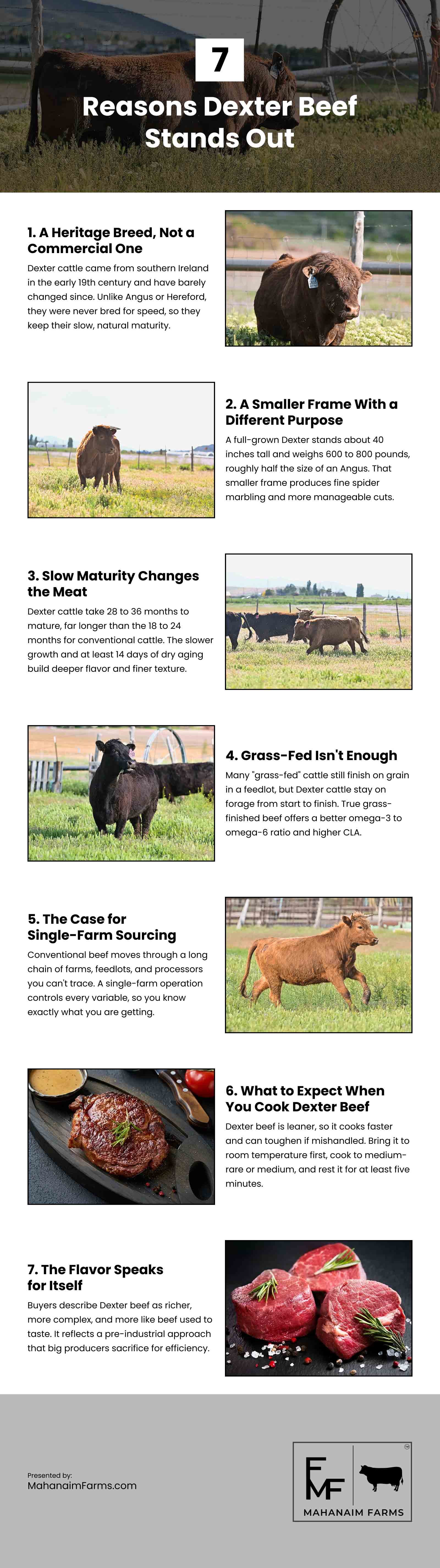
A Heritage Breed, Not a Commercial One
Dexter cattle originated in southern Ireland, likely in the early 19th century. They were bred as the working cow of small Irish farms, hardy enough to thrive on rough pasture and compact enough to manage on limited land. Since then, they have changed very little.
Modern commercial beef breeds like Angus and Hereford have been selectively bred for decades to reach market weight quickly. That efficiency serves production on a large scale, but it comes at the cost of flavor and eating quality.
Dexter cattle were never pushed through those same selection pressures. As a heritage breed, they retain strong foraging instincts, natural adaptability to pasture-based diets, and a slow-developing body. That slower, more natural maturity is a central reason the beef tastes the way it does.
A Smaller Frame With a Different Purpose
A full-grown Dexter cow typically stands around 40 inches tall and weighs between 600 and 800 pounds. A commercial Angus cow is nearly twice as tall and can weigh 1,400 pounds or more. The size difference changes almost everything about how the animal develops.
Smaller animals mature more gradually. Fat doesn’t accumulate in a rush. Instead, it develops alongside the muscle over a longer period, which allows the kind of marbling that shows up in a well-finished Dexter cut.
Dexter beef is also known for its spider marbling, a fine, weblike distribution of fat throughout the muscle. It’s different from the thick white ribbons you might see in a conventionally grain-finished steak. Spider marbling is more evenly distributed, which means the fat bastes the meat evenly from within as it cooks.
The Dexter ribeye or strip may be smaller than a conventional cut; a smaller animal means smaller cuts across the board. But the good thing about smaller cuts is that they are often more manageable for home cooks, less wasteful, and better aligned with nutritionists’ recommendations.
Slow Maturity Changes the Meat
Most conventional beef cattle reach market weight in 18 to 24 months. Dexter cattle, when raised with patience, typically take closer to 28 to 36 months. That time difference makes a huge difference in flavor.
When cattle grow quickly on high-energy grain diets, fat accumulates fast, but the nuance doesn’t develop. The beef tastes mild, almost bland, and while it’s consistent, it doesn’t have much flavor.
Slow-maturing cattle develop differently. Their muscle fibers are finer, which affects texture. Their fat develops over a longer arc, which affects flavor complexity. The beef from a slowly matured Dexter doesn’t need much help from marinades or heavy seasonings. The flavor is already there, grown over months in the pasture.
Dry-again adds another layer of complexity. Dexter beef is dry-aged for at least 14 days. This process allows the meat’s natural enzymes to continue breaking down muscle fibers and concentrating flavor. Slow maturity and proper dry aging work together to produce a noticeably superior product.
Grass-Fed Isn’t Enough
Most consumers have seen “grass-fed” on a beef label and assumed it means the animal ate grass its whole life, but that’s not necessarily true. Many commercial cattle start on grass and finish on grain in a feedlot. That feedlot phase is what puts the fast weight on before slaughter.
Grass-finished means the animal stayed on forage from start to finish. No grain finishing, no feedlot, no sudden diet shift at the end of the animal’s life. The flavor profile of a truly grass-finished animal reflects that consistency.
Dexter cattle are well-suited to forage-based diets. Their smaller frames and heritage genetics mean they can thrive on grass without requiring grain supplementation to hit market weight.
The fat composition in grass-finished beef is also different. Animals that eat grass throughout their lives tend to develop a different fatty acid profile than their grain-finished counterparts. You find a better omega-3 to omega-6 ratio, as well as higher levels of CLA (conjugated linoleic acid), a beneficial fat linked to heart health and metabolism.
The Case for Single-Farm Sourcing
Conventional beef has a long supply chain. Animals can move between multiple farms, feedlots, and processors before they’re packaged and sold. When you buy mass-produced beef at a grocery store, you usually can’t verify where the animal was born, what it ate, or how it was handled.
With a single-farm operation, those questions have clear answers. The farmer controls every variable. Feed and pasture practices stay consistent. Genetic history is tracked for each animal. The customer gets a product tied to one accountable source rather than an aggregated blend from multiple operations.
That transparency lets you know exactly what you are getting.
What to Expect When You Cook Dexter Beef
Dexter beef cooks differently from conventional beef, and it’s worth knowing what to expect before you fire up the grill.
Because Dexter cattle are grass-finished and slow-maturing, the beef is leaner than that of heavily grain-finished commercial beef. Leaner beef cooks faster and can become tough if you don’t handle it right. A few practical guidelines help you get the best flavor out of your Dexter beef:
- Pull the beef from the refrigerator 30 to 45 minutes before cooking to bring it closer to room temperature.
- Cook steaks to medium-rare or medium. High internal temperatures can dry out grass-finished beef more quickly than you might expect.
- Rest the meat for at least five minutes after cooking. Resting lets the juices redistribute before you cut into it.
The spider marbling in Dexter beef does a lot of the work for you. You don’t need heavy seasoning or a complicated technique. Salt, heat, and a little patience are usually enough.
The Flavor Speaks for Itself
There’s a reason heritage beef buyers describe Dexter beef as richer, more complex, and more like beef used to taste. Those descriptions make sense when you understand the breed.
Dexter cattle represent a pre-industrial approach to beef. Smaller animals. Slower growth. Pasture-based diets. Patient animal husbandry. This more mindful way of farming has fallen out of fashion because large manufacturers can’t replicate it. They sacrifice flavor for efficiency.
If you want to know what premium beef should actually taste like, Dexter beef is worth exploring. Cook it simply, and let the breed speak for itself.
Video

Infographic
Confusing beef labels make it tough to know what you are really paying for at the meat counter. Discover how the infographic below breaks down seven reasons Dexter beef stands out, from how it is raised to how it tastes.