Many home cooks have spent years honing their cooking techniques on supermarket beef. It can be disappointing to purchase a premium cut only to find it tough and dry. The same qualities that make premium beef taste better than anything you might find at the grocery store also mean that it responds differently when cooked.
Understand some key differences and make a few small adjustments to your technique to yield huge results.
Dexter Beef Cooks Differently
The differences start with the animal itself. Conventional grain-finished cattle develop a thick cap of external fat, the result of rapid weight gain on a grain-heavy diet. Fat conducts heat differently and helps insulate the meat during cooking.
Because Dexter beef is naturally leaner, there is less of that fatty protection. It’s important to pay close attention while cooking; the meat can go from perfect to overdone quickly, especially at high heat.
Instead of a big ribbon on the outside, the fat in Dexter beef develops as spider marbling. This is an intramuscular fat pattern that forms within the muscle tissue. The only way to get this superior fat distribution is through genetics and slow maturation, rather than grain feeding. Spider marbling contributes to a rich, complex flavor, but it doesn’t provide the same insulation as a heavy external fat cap.
Additionally, Dexter cattle are a small heritage breed, so the cuts are naturally smaller than conventional beef. It’s an important difference to note, especially when cooking steaks.
Steaks: Pull Them Earlier Than You Think
Those heritage beef steaks, like ribeye, New York strip, filet mignon, and sirloin, require lower heat and a shorter cooking time than conventional steaks. Medium-rare is the ideal target. An internal temperature between 130 and 135 degrees Fahrenheit yields a steak that’s tender, juicy, and fully expressive of the flavor that slow maturation develops.
A few practical adjustments make this easy to get right:
- Use a thermometer. Dexter beef is darker than conventional beef, so visual cues are less reliable guides than they are with a pale-pink supermarket steak.
- Pull early. Carryover cooking raises the steak’s internal temperature as it rests. Remove the steaks from heat about 5 degrees below your target temperature.
- Rest steaks before cutting. Let steaks sit for at least 5 minutes so the juices redistribute through the muscle rather than running out onto the cutting board.
A reverse sear approach works particularly well for thicker cuts. Start the steak in a low oven at around 250 degrees until it reaches 5 to 10 degrees below your target temperature, then finish with a hard sear in a very hot cast-iron pan. You get an even cook from edge to edge and a deep crust without the risk of drying out.
Ground Beef: Handle Less for Better Flavor
Dry-aged ground beef from Dexter cattle is more flavorful and more textured than conventional ground beef, and it responds well to gentle handling.
A few things to remember:
- Cook over medium heat. At high heat, a skillet evaporates moisture quickly, which can cause the ground beef to crumble and dry out before it’s fully cooked through.
- Stir as little as possible. When the meat is broken up too much, it can’t develop any browning or texture.
- Don’t press burgers. Pressing drives out the moisture, resulting in a dry, hard patty. Form the patties loosely, season simply, and let the beef do the work.
For applications like bolognese or meatballs, where the ground beef cooks in liquid, the lower fat content becomes a big advantage. The beef absorbs the flavors of the braising liquid or sauce more readily, and the natural depth of flavor of grass-finished heritage beef adds a richness that conventional ground beef doesn’t.
Roasts: Low and Slow Is the Key
Heritage breed beef really shows its depth in a long, slow cook. Chuck roasts from grass-fed, grass-finished Dexter cattle are well-suited to Dutch oven braising and slow cookers because slow maturation has already developed the connective tissue and mineral flavor that long cooking unlocks.
The approach is simple:
- Sear all sides. High heat builds a crust and establishes a strong flavor foundation.
- Braise in liquid. Beef broth, red wine, and aromatics like onion, garlic, and fresh herbs all work well.
- Cook low and slow. 275 degrees for 6-8 hours in an oven or slow cooker. Wait until the meat can pull apart easily.
- Don’t rush it. High heat tightens the muscle fibers before the collagen has time to break down, resulting in a tough rather than tender texture. Patience here is an essential ingredient.
The flavor of a properly braised heritage beef roast is noticeably different from that of a conventional chuck roast. The pasture-raised flavor, concentration from dry aging, and fine muscle fibers from slow maturation all contribute to a noticeably richer result.
Short Ribs: Built for the Braise
Short ribs are one of the most popular cuts of beef and are a place where Dexter beef really shines. The slow maturation of Dexter cattle develops the connective tissue in the ribs in a way that responds beautifully to long, gentle heat.
The approach is similar to the roast:
- Sear the ribs. Let a crust develop on all sides of the ribs. This develops the flavor, enhances the texture, and maintains the color.
- Braise in a Dutch oven. Cook at 325 degrees for 2–3 hours. The ribs are done when the meat pulls back from the bone and a fork slides through without resistance.
- Create the sauce. After removing the ribs, skim the liquid and reduce it over medium-high heat until it thickens.
Short ribs reward patience and simplicity. Overcomplicating the recipe pulls attention away from the sought-after grass-finished beef flavor.
Make the Most of What You Ordered
The adjustments are small, but the payoff is significant. Dexter beef raised on pasture and finished on grass develops a depth of flavor that commercial beef can’t match. Once you dial in the right technique for each cut, you’ll find it hard to go back.
Lower the heat, monitor the internal temperature, and use the right technique for each cut to preserve that premium flavor and quality.
Video

Infographic
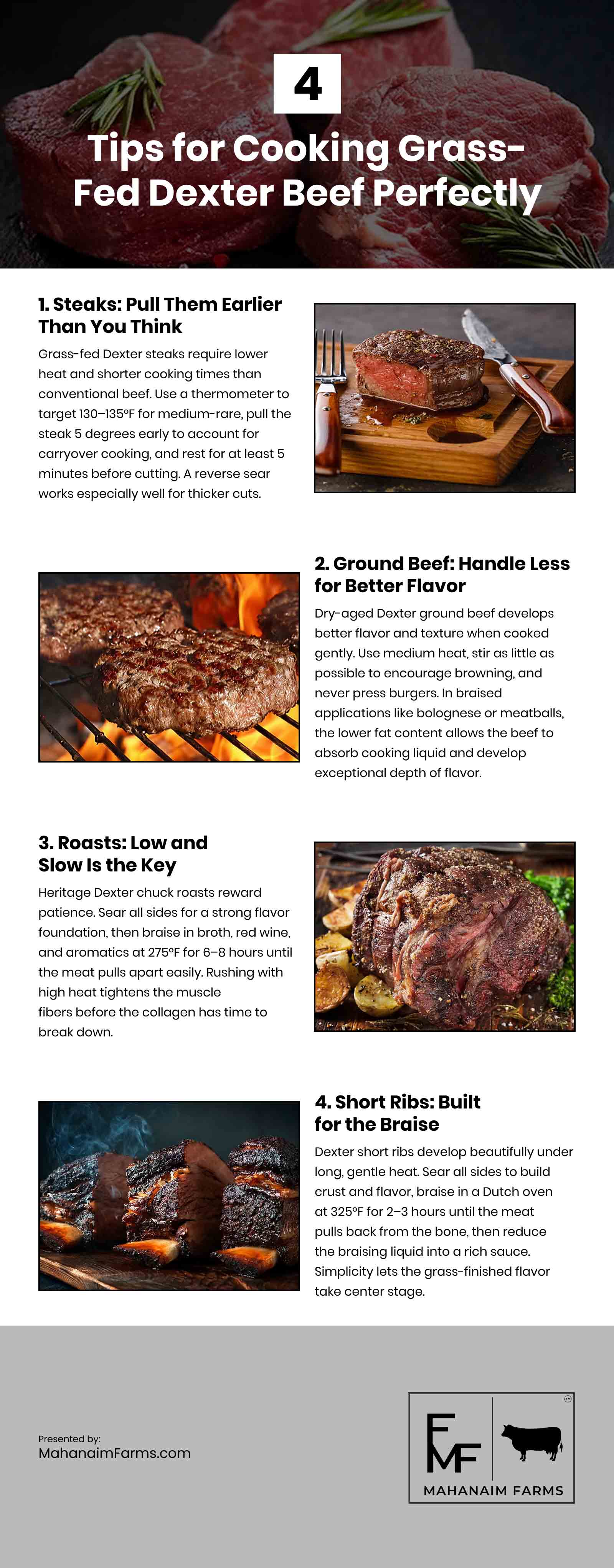
Grass-fed Dexter beef is fundamentally different from conventional beef, and getting the best from it means understanding how its superior quality alters how it responds to heat and time. Explore tips for cooking grass-fed Dexter beef perfectly in this infographic.